What is a Dead Man's Wire?
What Is a Dead Man’s Wire? The Origins and Evolution of a Fail-Deadly Phrase
- A “dead man’s wire” is a modern term derived from the 1977 Tony Kiritsis hostage crisis in Indianapolis, where the perpetrator used a homemade shotgun device he called a “dead man’s line.”
- The device functioned as a fail-deadly system — if Kiritsis were shot or fell, the shotgun would fire and kill his hostage instantly.
- The term evolved from the engineering concept of a dead man’s switch and the military idea of a tripwire.
- “Dead man’s line” was the phrase Kiritsis himself coined; “dead man’s wire” became popular decades later through film and media retellings.
- The 2018 documentary Dead Man’s Line preserved the historical terminology, while the 2025 feature film Dead Man’s Wire introduced the modern version now used in popular culture.
Introduction: Anatomy of a Phrase
The phrase “dead man’s wire” has no single, simple origin. It emerged from a complex, decades-long interplay between a shocking real-life event, pre-existing technical jargon, and a chain of media retellings that reshaped public memory.
The term is a modern, cinematically driven reinterpretation of an earlier phrase—“dead man’s line.” That original term was not coined by journalists or police but by the man who created the device himself during one of the most extraordinary hostage crises in American history: the 1977 Tony Kiritsis standoff in Indianapolis.
This article traces how that phrase evolved—from its terrifying debut on live television to its modern rebirth through documentary and film. It explores four layers of meaning: the 1977 incident itself, the technical roots of the concept, the semantic evolution of line / wire / switch, and the powerful role of popular media in transforming language into legend.
The Indianapolis Siege: The Birth of a “Dead Man’s Line”
The story begins with one man—Anthony G. “Tony” Kiritsis—and a weapon of his own design. On the morning of February 8, 1977, Kiritsis, a 44-year-old real-estate developer, entered the downtown Indianapolis offices of Meridian Mortgage Company, convinced that the firm had cheated him out of his property. Seeking revenge and leverage, he took Richard O. Hall, the company’s executive and the son of its president, hostage.
The Device
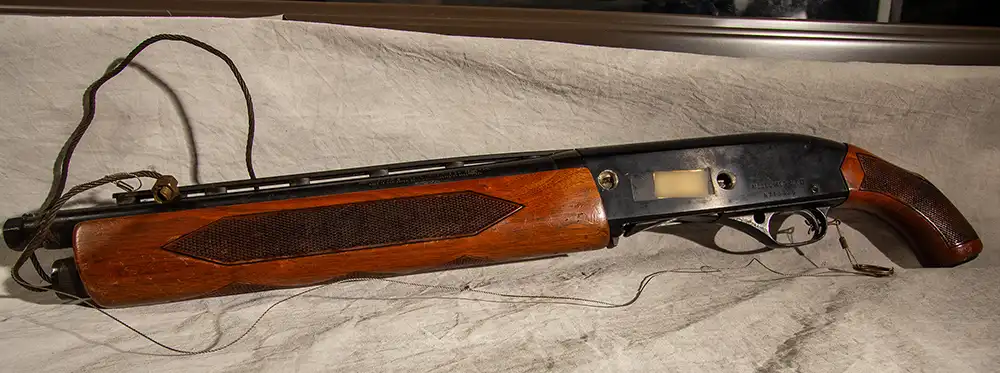
Inside Hall’s office, Kiritsis produced a sawed-off 12-gauge Winchester 1400 shotgun and built a crude mechanical linkage using wire. One line ran from the gun’s muzzle to a noose around Hall’s neck; another attached to the trigger. If Kiritsis were shot or stumbled, the tension on the wire would pull the trigger and kill Hall instantly—a fail-deadly system in its purest form.
Reports differ slightly on the exact wiring—some say the trigger wire looped around Kiritsis’s finger, others around his own neck—but the function was unmistakable: if the gunman fell, his hostage died.
Naming the Invention
The most revealing detail is that Kiritsis himself named his device. Eyewitnesses and later accounts, including Indianapolis Monthly, note that he described it as a “dead man’s line.” In that moment, he was both inventor and lexicographer—coining the term that would outlive him. Contemporary and historical sources, including Wikipedia and court transcripts, consistently cite “dead man’s line” as his exact wording.
The Public Spectacle
Kiritsis forced Hall onto the streets, parading him for blocks in sub-freezing temperatures, surrounded by police and television crews. Photographer John H. Blair of United Press International captured an image of the pair—Hall’s head wrapped in wire, Kiritsis gripping the shotgun—that won the 1978 Pulitzer Prize for Spot News Photography. That single image etched the phrase “dead man’s line” into America’s collective consciousness.
Deconstructing the Device: Technical and Linguistic Precursors
The “Dead Man’s Switch”
Kiritsis’s mechanism was not invented in a vacuum. It borrowed from an engineering principle first developed in the early 1900s: the dead man’s switch. Originally used in trains and electric trolleys, these devices automatically stopped machinery when an operator released pressure—ensuring safety if the operator became incapacitated.
Yet the same logic can be inverted. A fail-deadly version acts in reverse: if the operator dies or releases control, it triggers destruction instead of safety. Cold-War systems such as the Soviet “Dead Hand” nuclear protocol, or even personal “insurance files” meant to release data upon death, reflect this darker variant. Kiritsis’s rig was a homemade, single-target embodiment of that principle.
The “Tripwire”
Another linguistic ancestor is the tripwire—a passive trigger first used in World War I trenches to detonate explosives or alarms when disturbed by an intruder. Unlike the dead man’s switch, which the operator controls, a tripwire is triggered by the victim.
Kiritsis’s “line” was a fusion of both ideas: a manually controlled dead man’s switch fashioned from literal wire. His chosen term combined the “dead man” prefix of fail-deadly systems with the tactile immediacy of a wire stretched between two doomed men.
| Term | First Known Use / Context | Primary Meaning |
|---|---|---|
| Dead Man’s Switch | Early 1900s (railways) | Stops or triggers machinery if the operator becomes incapacitated. |
| Tripwire | c. 1915 – WWI | Wire that detonates or alarms when disturbed by a third party. |
| Dead Man’s Line | 1977 – Kiritsis incident | The homemade, fail-deadly shotgun device coined by Kiritsis. |
| Dead Man’s Wire | c. 2024 – Film promotion | Modernized, cinematic variant popularized by the 2025 feature film. |
A Tale of Three Terms: “Line,” “Wire,” and “Switch”
Each variation of the phrase reveals a different layer of meaning and history.
- Dead Man’s Line — The original term, coined by Kiritsis. Line evokes both a literal cable and a metaphorical boundary—a lifeline held in tension. The 2018 documentary Dead Man’s Line preserved this authentic terminology.
- Dead Man’s Switch — The engineering term describing the functional principle behind the device. Technically accurate but emotionally sterile, it appears mainly in analytical discussions.
- Dead Man’s Wire — The modern reinvention. Wire is tactile, cinematic, and instantly visual—qualities that made it the natural choice for the 2025 Gus Van Sant film Dead Man’s Wire. The movie’s title effectively rebranded the phrase for a global audience, demonstrating how cinema can rewrite linguistic history.
The Media Echo Chamber: How Language Becomes Legend
The phrase’s evolution from line to wire mirrors the media’s role in myth-making. Every retelling—journalistic, documentary, or dramatic—has reinforced or reshaped the vocabulary attached to the event.
1977: The Live Broadcast
The Kiritsis standoff unfolded live on radio and television—an unprecedented media phenomenon. Newsman Fred Heckman of WIBC became Kiritsis’s reluctant intermediary, while the public listened in real time as a potential murder played out over the air. The coverage raised profound ethical questions about journalism’s boundaries but also ensured that the phrase “dead man’s line” entered the national lexicon overnight.
2018: Documentary Canonization
The award-winning film Dead Man’s Line revisited the case as historical reconstruction, solidifying Kiritsis’s original terminology as canonical.
2025: Cinematic Reinvention
The upcoming Gus Van Sant film Dead Man’s Wire—starring Bill Skarsgård, Al Pacino, Dacre Montgomery, and Colman Domingo—marks the phrase’s final transformation. Its title converts a local historical term into a global cultural artifact, ensuring that “wire,” not “line,” will dominate future retellings.
| Title / Medium | Primary Term Used | Narrative Focus | Linguistic Impact |
|---|---|---|---|
| Pulitzer Photo (1978) | (visual) | Raw imagery of the device | Cemented the horror in public memory |
| Dead Man’s Line (2018) | “Line” | Historical reconstruction | Canonized original term |
| American Hostage (2022) | — | Media ethics and psychology | Shifted focus from device |
| Dead Man’s Wire (2025) | “Wire” | Stylized true-crime drama | Popularized modern variant |
Conclusion: The Enduring Legacy of a Phrase
The term “dead man’s wire” did not appear overnight—it evolved through nearly five decades of linguistic and cultural transformation.
- Conceptual Foundation: Born from the century-old principle of the dead man’s switch, inverted into a fail-deadly mechanism.
- Historical Crystallization: Coined as “dead man’s line” by Tony Kiritsis during the 1977 Indianapolis hostage crisis.
- Media Canonization: Reinforced by real-time broadcasts and the 2018 documentary Dead Man’s Line.
- Cinematic Evolution: Rebranded as “dead man’s wire” by the 2025 film, proving how popular culture can reshape language itself.
What began as one man’s chillingly descriptive term has become a lasting piece of American linguistic folklore—an unsettling symbol of desperation, control, and the fatal logic of fail-deadly design.