Tony Kiritsis – Frequently Asked QuestionsThe 1977 Tony Kiritsis hostage standoff reshaped how America viewed crime, media, and mental health. This FAQ covers the basics — but it’s only part of the story. Explore the full account, from the original recordings to the upcoming film Dead Man’s Wire, across this site.
1. What did Tony Kiritsis do?
In February 1977, Indianapolis businessman Tony Kiritsis kidnapped bank executive Richard O. Hall, wiring a shotgun to his own body in what he called a
“dead man’s line.” The 63-hour standoff stemmed from a bitter land-financing dispute with Hall’s company, Meridian Mortgage. ➡
How it began2. What is a dead man’s line?
A
dead man’s line was the name Tony Kiritsis gave to the shotgun rig he built during the 1977 hostage standoff. He wired the gun’s trigger to his own body so that if police shot him or he released pressure, it would fire automatically and kill his hostage, Richard Hall. The device created a deadly standoff that Kiritsis described as “foolproof” — a literal life-or-death line between them. In 2025, the Gus Van Sant film
Dead Man’s Wire reinterpreted this device, renaming it the
“dead man’s wire,” a term that has since become synonymous with the event itself. ➡
Read more3. Why did Tony Kiritsis take a hostage?
Kiritsis believed Meridian Mortgage, led by M.L. Hall, had cheated him in a land deal and was destroying his business reputation. He wanted public vindication and a platform to tell his side of the story.
4. What was the dispute about?
Tony Kiritsis owed payments on a loan from Meridian Mortgage for land he was developing on his own. He believed M.L. Hall, the company’s president and father of hostage Richard Hall, was warning potential tenants not to lease from him. Tony planned to build a small retail strip on the property but felt Hall’s interference ruined his project and reputation.
5. Who was Richard Hall?
Richard Hall was a bank executive and the son of Meridian Mortgage president M.L. Hall. On February 8, 1977, Tony Kiritsis went to the Meridian offices intending to confront M.L. Hall, who was on vacation in Florida. Instead, he took Richard hostage, triggering one of the most widely covered standoffs in American history. In the upcoming film
Dead Man’s Wire, Hall is portrayed by actor Dacre Montgomery. ➡
Read how Richard Hall got the last word6. Where and when did the Tony Kiritsis hostage situation occur?
The Tony Kiritsis hostage standoff began on February 8, 1977, at the Meridian Mortgage offices located at 129 East Market Street in downtown Indianapolis, Indiana. It ended 63 hours later at Crestwood Village Apartments on the city’s west side, where Kiritsis finally released his hostage, Richard Hall. ➡ Watch historic coverage →
Kiritsis Video Archive7. Was the event broadcast live on TV or radio?
Yes. Portions of the 1977 Indianapolis standoff were broadcast live on local radio and television, including
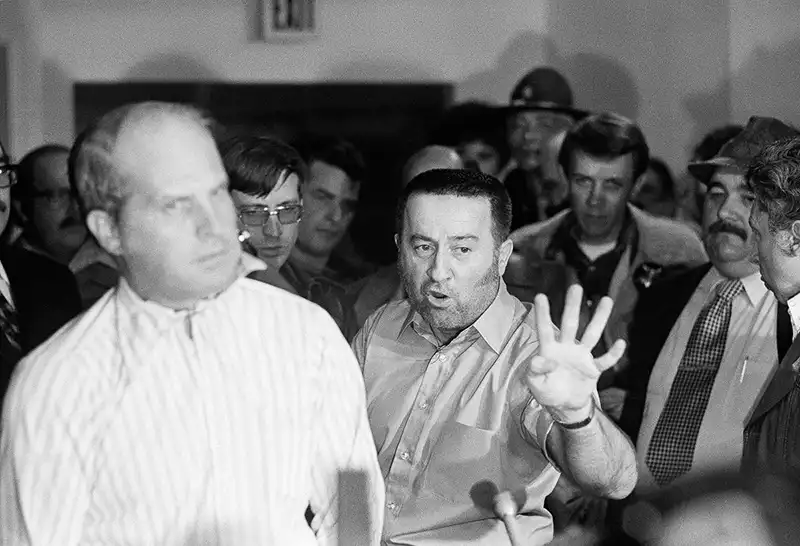
Tony Kiritsis’s emotional press conference that stunned viewers nationwide.
8. What did Tony Kiritsis say in his 911 call?
In his first call to police, Tony Kiritsis calmly but defiantly announced that he had taken a hostage and wired a shotgun to both men so that any attempt to stop him would kill them instantly. Speaking with striking clarity, he demanded to speak with specific officers he trusted, explained that he felt ruined and betrayed by a mortgage company, and warned authorities to follow his instructions exactly. The call set the tone for what became a 63-hour televised standoff — a mix of control, desperation, and fury that shocked the city and previewed the “dead man’s line” device that defined the case. ➡ Hear the recording →
Tony Kiritsis 911 Call (Uncensored)9. When and how did Tony Kiritsis die?
Tony Kiritsis was born in 1932 and died in January 2005 in Indianapolis at the age of 72. After spending more than a decade in a state mental hospital following his 1977 insanity verdict, he lived quietly under supervision until his death from natural causes.
10. What happened to Tony Kiritsis’s property?
Tony Kiritsis purchased a 17-acre parcel at Lyndhurst Drive and Rockville Road on Indianapolis’s west side for **$130,000**, intending to build a shopping center. After his 1977 acquittal by reason of insanity, the state moved to have him committed to a mental hospital as incompetent and dangerous. During that time, he transferred the land to his brothers, **Jimmie Kiritsis** and **George Urgo**, as co-trustees in an effort to sell it. In late December 1978, a foreclosure trial began. The property was valued at approximately $550,000, with an outstanding mortgage of about $175,000 from interest, taxes, and legal costs. When the brothers couldn’t find a buyer, Meridian Mortgage—the lender at the heart of the dispute—forced a sheriff’s auction and regained ownership of the property in November 1979. A spokesman for Meridian said afterward that the company had “no immediate plans for the property” and would likely sell it, adding, “We really don’t want it because we’re not in the real estate business.”
11. Did Richard “Dick” Hall write a book about the hostage crisis?
Yes — in 2017, Richard O. “Dick” Hall co-authored
Kiritsis & Me: Enduring 63 Hours at Gunpoint, where he recounts his time held by Tony Kiritsis and reflects on the experience. ➡
Kiritsis & Me: Enduring 63 Hours at Gunpoint12. Where can I hear Tony Kiritsis’s real recordings?
You can hear the original 1977 recordings — including news coverage, press conferences, and courtroom footage — right here on this site. We host the **largest and most complete archive of Tony Kiritsis audio and video recordings** available anywhere. ➡
Explore the Kiritsis Video Archive13. Is Dead Man’s Wire based on this story?
Yes.
Dead Man’s Wire, directed by Gus Van Sant and starring Bill Skarsgård, dramatizes the same 1977 events depicted in the award-winning documentary
Dead Man’s Line. ➡ Film info →
Dead Man’s Wire